

The story usually begins the same way.
You think you still have plenty of time. So you sit down at 9 PM and tell yourself, “Just ten minutes.”
You start checking your phone. Scrolling. Relaxing. Then suddenly, you glance at the clock, and it’s 1 AM.
Nothing dramatic happened. You didn’t go anywhere. Yet somehow, the hours vanished. How is that possible?
It can feel as if the night disappears faster than the day.
But here’s the truth.
No, time does not move faster at night. The clock moves at the same steady pace. But your brain doesn’t experience time the same way after dark. What you’re feeling is something psychologists describe as nighttime time compression, when duration feels shorter than it really is.
Let’s explore why that happens.
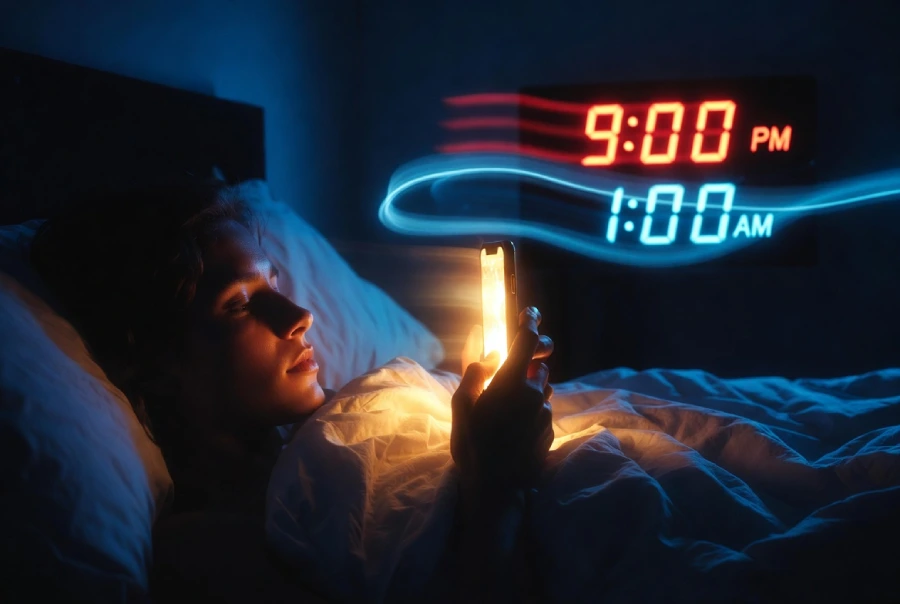
Table of Contents
When Structure Disappears, Time Blends Together
During the day, your life is divided into segments. Meetings start and end. The phone rings suddenly. Work stops and starts again. Emails interrupt you. Traffic slows you down. Lunch breaks happen. These little events act as psychological boundaries.
In psychology, they are called stopping cues, which tell the brain that time is passing.
But at night, these boundaries are relaxed.
There are fewer interruptions. Less noise. No deadlines pressing in. Without these natural markers, your brain struggles to divide time into manageable pieces. Instead, the hours blend together into one continuous experience.
When there are no signals to divide time, all time blends together. And when time does blend, it feels shorter, which makes it seem like time goes by faster at night.
The Infinite Scroll Effect
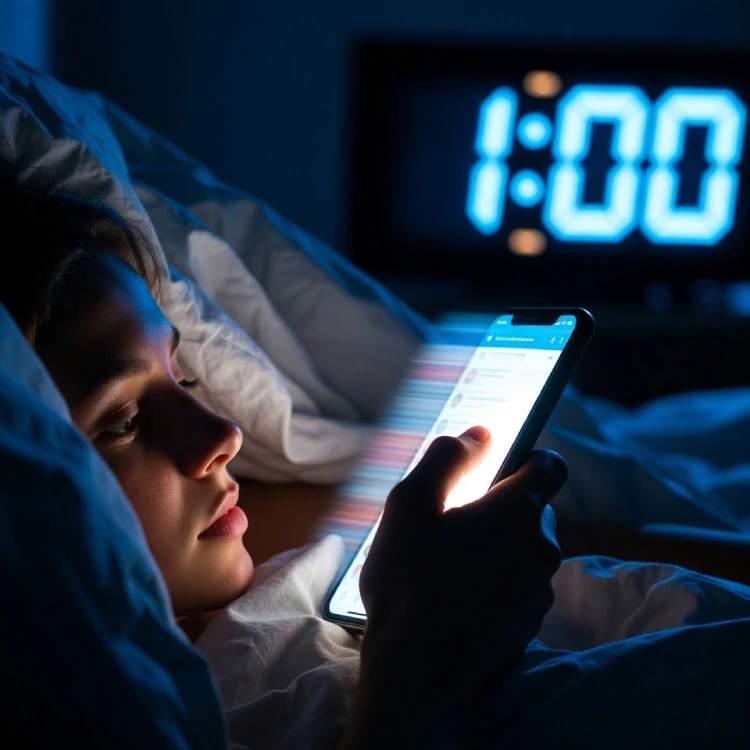
Nowadays is the time of technology, and in this time we are all addicted to social media, such as Facebook, YouTube, Instagram, Twitter, TikTok, and many more. Social media is designed in such a way that there is no “end,” and there is no shortage of interesting stories. Social media is the best platform for developing one’s own talent.
Once you enter, you cannot understand where time goes, because there is no shortage of interesting hooks. There is no end to anything; one interesting story after another keeps coming.
Research in cognitive psychology shows that continuous digital reward systems activate dopamine pathways in the brain, increasing focus while reducing awareness of passing time.
Dopamine:
- Increases attention
- Shrinks awareness
- Reduces sensitivity to time
This is related to the Attention-Gate Model. When attention is narrowed, fewer internal time signal is processed.
That is, you are busy, but you are not counting how time is passing quickly.
That is why it seems like three hours and thirty minutes.
Revenge Bedtime Procrastination
You don’t have time to yourself all day. Because, most of the day is spent at work, studying, responsibilities, and expectations. But the night is often the only time that feels truly personal.
Psychologists call it revenge bedtime procrastination: intentionally delaying sleep so that you can enjoy your own time.
Subconsciously, checking the clock signals that freedom is running out, so you avoid it. You delay it. You stretch the moment.
When you regain control, the hours pass silently.
Your Biological Clock Shifts Into Night Mode
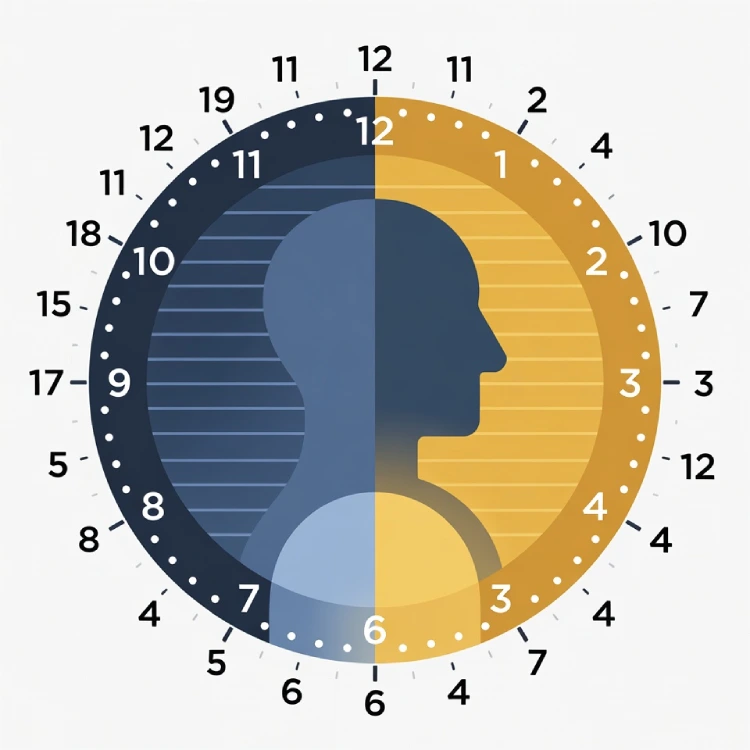
There is a part of our brain called the Suprachiasmatic Nucleus (SCN). It controls your circadian rhythm.
For example, at night:
- Melatonin increases.
- Body temperature decreases.
- Alertness decreases.
- Thinking slows down.
Research in cognitive neuroscience suggests that when alertness decreases, the brain generates fewer internal timing signals.
If your internal pacemaker slows down, then external time seems to move faster.
That means the clock doesn’t change. Only the processing changes.
Memory Compression: Why Evenings Feel Short in Hindsight
We know that the brain measures time not in seconds, but in events.
Every day, there are many new experiences. For example:
- Talking
- Making decisions
- New tasks
- Managing family
- Getting through events
- Unexpected events, etc.
Each event creates a new memory marker. The more events, the more memories.
But at night, most tasks are repetitive. For example:
- Phone scrolling
- Watching series
- Lying in bed
- The same routine
Fewer new events mean fewer memory markers.
Later, when you think about the night, the brain compresses the entire time. This is called Retrospective Time Compression.
Novelty lengthens time, and routine shortens time.
This is why the summer of childhood seems endless, while the weeks of adulthood seem to disappear.
Dopamine and the Flow State
Nighttime is usually a time of pleasure. Gaming, social media, chatting, or watching shows all trigger dopamine release.
When you do something that is enjoyable, dopamine is released.
Dopamine:
- Increases attention
- Reduces time awareness
- Encourages you to keep going
With deep concentration, you can enter a flow state. In this state, awareness fades significantly. Hours can feel like minutes.
The more you indulge yourself, the less your brain tracks time. You lose awareness of time, so you don’t notice how time passes. The night will seem much shorter.
Decision Fatigue Reduces Self-Monitoring
At the end of the day, your mental energy decreases. Because you have made hundreds of decisions, big and small, throughout the day. For example:
- What to say
- What to answer
- Which task to do first
This creates decision fatigue.
When mental control decreases:
- Self-monitoring decreases
- The tendency to look at the clock decreases
- Time awareness decreases
When you stop monitoring time, time seems to pass quickly. So your mind goes faster at night.
Emotions Feel Louder at Night
At night, there is less external noise. As a result, the environment is quieter, which leads to stronger internal thoughts.
For some people, relaxation may be deeper. For others, anxiety increases.
Research in emotional cognition suggests that strong emotional states can distort how we judge duration. When the same thoughts are repeated over and over again, time seems much shorter. It is not understood how time passes so quickly.
Chronotype Differences
Not all people spend their nights the same way. Different people enjoy the night in different ways. The main reason for this is chronotype—that is, when one’s body clock is most active.
Morning-type people gradually become less alert after the evening. Attention and energy decrease at night.
Night-owl people are relatively more alert at night. Thinking and focus seem clearer then.
However, chronotype alone does not explain everything.
Both groups are affected by:
Passive repetition: doing the same low-effort activities again and again
Low-structure environments: situations without clear schedules, boundaries, or defined start and end points
Alertness changes how experiences feel, but it does not fully control how time is perceived. What matters more are:
- Novelty
- Segmentation—breaking time into clear, distinct activities
Regardless of chronotype, low-boundary environments compress perceived time, making hours feel like they pass very quickly.
Does Physics Play Any Role?
From a physics point of view, time flows at a constant rate on Earth. Time only changes under extreme conditions, such as:
- Very strong gravitational forces
- Travel at speeds close to the speed of light
Nighttime does not change Earth’s gravitational conditions in any way that could affect the flow of time.
So, time does not actually move faster at night.
The feeling that time passes quickly at night is not caused by physics.
It is entirely due to neurological and psychological processes. How the brain processes attention, memory, and experience.
In short:
The clock stays the same; only our perception of time changes.
If you want to see how time differs across regions, you can check the current time in different countries.
How to Slow Down Time at Night
If your evenings seem to disappear too quickly, small structural changes can help reduce nighttime time compression.
- Set visible 20–30 minute timers
Seeing time pass creates clear boundaries. - Break scrolling into defined sessions
Avoid endless scrolling by deciding when to start and when to stop. - Switch activities intentionally
Conscious transitions divide time into noticeable segments. - Introduce one small new experience each day
Novelty helps the brain mark and remember time. - Reduce blue light exposure before sleep
Blue light disrupts natural signals and worsens time blur. - Track your time consciously
Paying attention to how time is spent sharpens time awareness.
Why this works
- Stopping cues create boundaries
- Novelty creates memory markers
Together, they stretch perceived time, making nights feel longer and more complete.
You can also use a time calculator or time tracking tools to monitor your evenings more consciously.
Conclusion
Time does not speed up at night. What changes is how your brain processes it.
At night your brain tends to:
- lose external stopping cues
- narrow attention via reward‑driven loops (dopamine)
- generate weaker internal timing signals
- form fewer distinct memory markers
- suffer decision fatigue
- reduce self‑monitoring
Together, these factors produce the illusion that time is accelerating.
The night does not steal your hours — your perception reshapes them.
FAQs
Does time actually move faster at night?
No. Physical time on Earth runs at a constant rate (seconds stay seconds). The sense that nights pass faster is a psychological effect: in the evening alertness often drops, attention narrows, and activities tend to be less novel or more repetitive, so the brain forms fewer distinct memory markers. With fewer markers, retrospective duration feels compressed even though clock time is unchanged.
Why does scrolling make hours disappear?
Scrolling compresses perceived time because it removes natural stopping cues, hijacks attention with frequent small rewards, and reduces the formation of distinct memory markers. Social apps are deliberately designed to maximize engagement—continuous new content, surprises, and intermittent rewards (likes, novel posts) keep you hooked and make it hard to notice time passing. The net effect: internal time monitoring weakens, attention narrows, and long stretches of clock time feel much shorter than they actually are.
Does melatonin directly change time perception?
No, melatonin does not change the physical flow or “speed” of time. However, it does affect subjective time perception indirectly. Melatonin promotes sleepiness and reduces alertness, slows certain neural processing (reaction times, attentional switching), and shifts arousal state. Those changes make the brain less accurate at estimating durations and can produce a compressed or blurred sense of time. There is no solid evidence that melatonin directly alters time itself; its effects on perceived duration are secondary to changes in alertness and neural processing.
Why do evenings feel shorter than mornings?
Evenings often feel shorter for psychological—not physical—reasons. Mornings typically have higher information density, more decisions, and clearer structure (work tasks, planning, new stimuli), which produce many distinct memory markers and stretch retrospective perception. Evenings, by contrast, tend to be more routine, passive, or low‑boundary (open‑ended scrolling, watching similar content, fewer decisions), so the brain encodes fewer distinct events. With fewer memory markers and lower alertness, retrospective duration is compressed and the same clock time feels shorter.
Why does time feel faster as we get older?
Because we experience less newness, life becomes more routine, and each year is a smaller fraction of our life. Together, these reduce distinct memory markers and encoded detail, so months and years blend and feel shorter in retrospect.
How can I prevent losing track of time at night?
Add simple structure and boundaries. Use 20–30 minute visible timers or hard‑stop alarms, switch activities deliberately, limit passive scrolling, reduce blue light before bed, and add one small new thing each evening. These cues and novelty help the brain form memory markers and prevent nights from slipping away.
